
A market in Vrsar, late October
Think of a stall at the edge of the Vrsar market on a weekday morning in late October. It sells a few kinds of truffle and not much else. The air is cool enough for a jacket, and the woman running the stall has time for a long talk with the fish vendor next to her. There are only a handful of tourists in the whole market. In July this same strip of stalls would be elbow to elbow by nine in the morning, selling lavender sachets and cheap sunglasses to people walking back from the beach.
Nothing about the weather explains that difference. Two mornings in that market can have much the same weather and feel like different towns. What changed was who was there, what was for sale, and how fast anyone seemed to be moving. That's the thing nobody tells you when they hand you a rain chart for Croatia: the chart answers the wrong question.
What the calendar actually changes
Travel advice boils seasonality down to temperature and precipitation, those numbers are easy to grab and compare. But in Istria and on the islands, the calendar shifts far more than the thermometer.
Ferry frequency is the clearest example. Jadrolinija runs the Split-Hvar-Korčula-Dubrovnik catamaran line something like a dozen times a day in August and a fraction of that in February, and the winter timetable can mean one boat connecting an island to the mainland, period, with no backup if you miss it. You can check the current routes directly on Jadrolinija's own schedule, and it's worth doing before you lock in island-hopping dates instead of after.
Restaurants close, too, and not always for the reason you'd expect. Plenty of family-run konobas shut for two to three weeks in November or early December, not because business is bad but because that's the owner's one break of the year after six straight months of double shifts. A sign on the door reading "zatvoreno zbog godišnjeg odmora" means "closed for annual leave," and it will not reopen for your dinner reservation no matter how good your Croatian is.
Food availability shifts with what's in season, which in Istria has its own calendar. White truffle season runs roughly October through December, when restaurants in Buzet and Livade build entire tasting menus around a fungus that costs more per gram than silver some years. Spring brings wild asparagus, šparoge, foraged from roadside ditches and sold in bundles at weekend markets from March into April. Ask for a truffle dish in June and you'll get the cultivated black summer truffle, a different thing entirely, milder and less expensive. None of that shows up on a weather app.
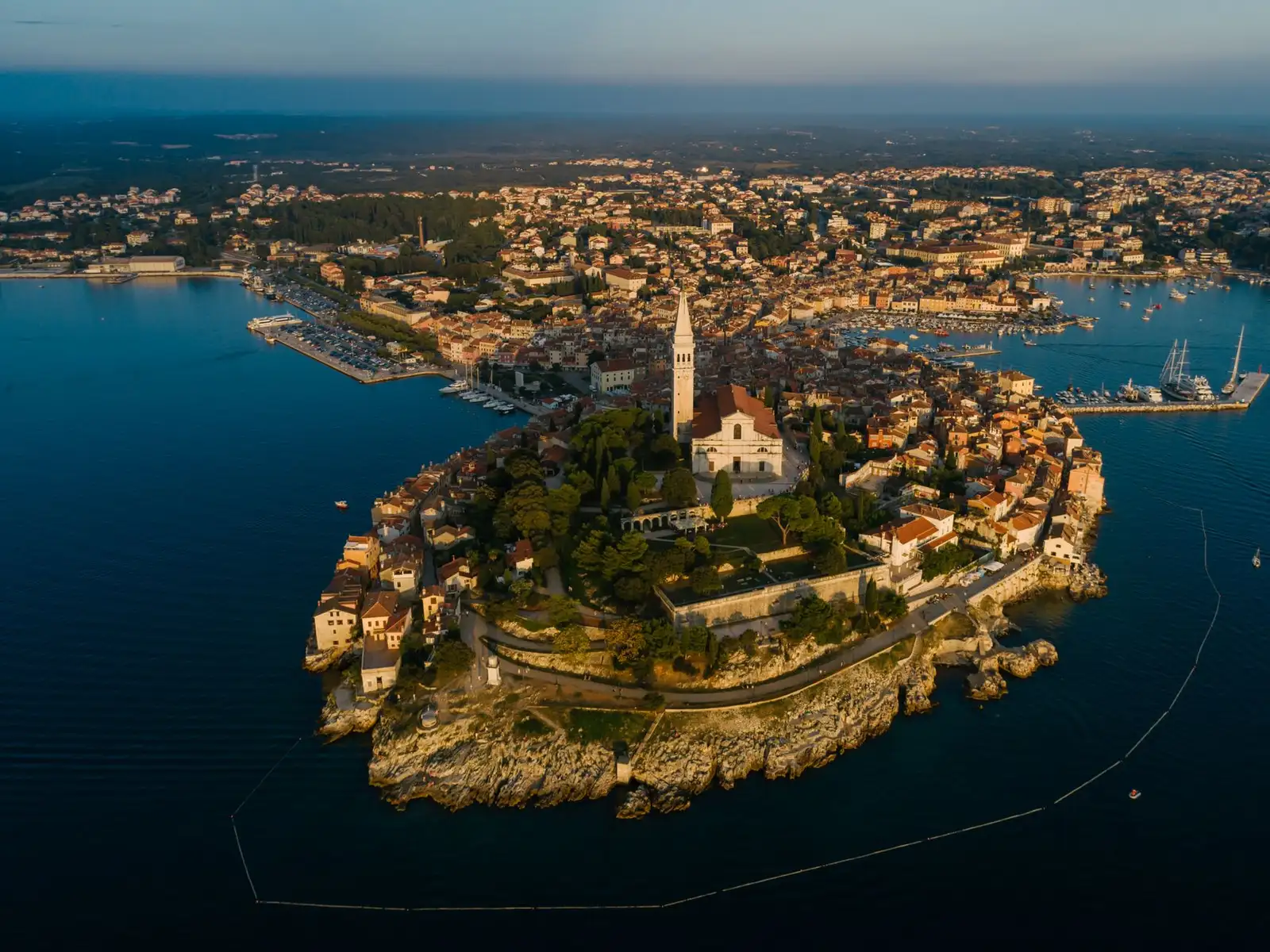
And then there's density, which changes the texture of a place more than anything on this list. Rovinj's old town in peak August holds a population that, by rough local estimate, outnumbers full-time residents something like ten to one on the busiest days. Walk the same cobbled lanes in late September and you'll hear Croatian spoken on the street more often than German or Italian, and the waiter who served you will sit down for a minute if the restaurant's half empty.
Istria's year, month by month
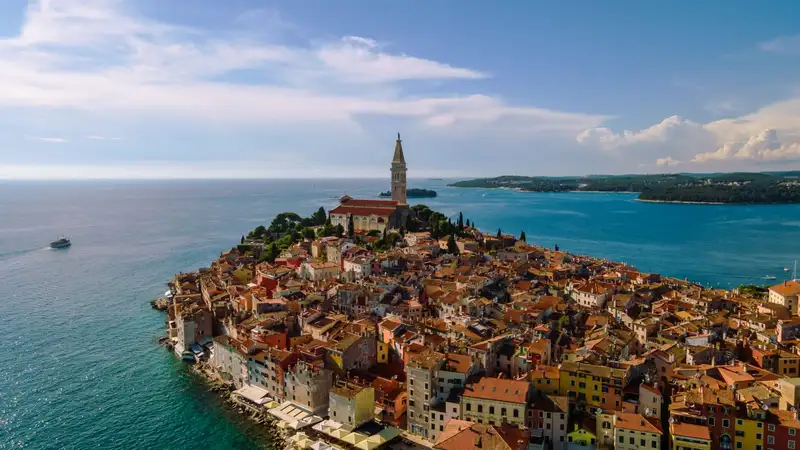
Istria runs on a rhythm that has more to do with olives, grapes, and truffles than with sun hours. March and April bring the asparagus foraging and the first warm market days, with towns like Motovun and Grožnjan still quiet enough that you can hear the church bell from three streets over. May is when the hill towns wake up: wine bars open their terraces, the Motovun forest fills with mushroom hunters on weekends, and the coast starts to warm without the crowds.
June through August is peak season on the coast, full stop. Poreč and Rovinj fill with German, Austrian, and Italian families who've been coming to the same campsites for three generations, and the beach clubs run at full tilt. It's the best window for swimming, the busiest window for everything else, and the one month restaurants without reservations will turn you away flat.
September is the pivot point. Sea temperatures hold into the low twenties through most of the month, the crowds thin by half after the first week, and the grape harvest in the hills around Momjan and Buzet starts pulling locals out of the coastal towns and into the vineyards. By October, truffle season takes over the conversation entirely, the Istrian coast empties out, and the hill towns hit their best stretch of the year for anyone who wants to talk to the person pouring the wine.
Winter in Istria isn't dead, but it's a different kind of place. Many coastal hotels and restaurants close outright from November through March. The inland towns stay open because locals still need to eat, but the tourist infrastructure built for July simply isn't running, and you'll want to check opening hours before driving forty minutes to a restaurant that turns out to be shuttered until Easter.
The islands: same sea, very different clocks
Hvar, Vis, and Korčula sit less than a hundred kilometers apart as the ferry runs, and they experience the calendar in almost opposite ways.
Hvar Town in August is nightlife, full stop: yacht traffic in the harbor, bass from the beach clubs carrying up into the old town after midnight, and a population that triples or quadruples depending on who you ask at the tourist office. That's a particular kind of trip and a lot of people want exactly that. But Hvar in June, before school holidays start across central Europe, gives you the same lavender fields and the same Venetian loggia in the main square with a fraction of the noise.
Vis is the outlier, and the history explains why. The island was a closed Yugoslav military zone until 1989, off-limits to foreign visitors for decades, which meant it skipped the big resort development that reshaped Hvar and Korčula through the 1970s and 80s. BBC Travel's reporting on Vis's post-military reopening lays out how that isolation left the island with far less built infrastructure than its neighbors, even now. The practical result: Vis in August is still busy, but nothing like Hvar, and in September it can feel closer to a working fishing community than a destination at all.
Korčula Town splits the difference. July and August bring cruise tenders and day-trip crowds into the old town's narrow streets, but the island's interior, the vineyards around Smokvica and Čara producing the local Pošip white wine, barely notices the tourist calendar at all. The wine harvest in mid-September pulls whole families into the fields regardless of how many tourists are still on the ferry.
The timing of your island visit also decides how you move between them. In the piece on pacing a trip through Andalusia, the argument is that sequence matters as much as destination choice, and islands make that case even more sharply, because missing a ferry connection in shoulder season can cost you a full day instead of an hour. Build island-hopping itineraries around the reduced September-to-May schedules, not the July timetable you found first on a travel forum.
The mood shift nobody puts on a brochure
Ask a bartender in Rovinj how they're doing in the third week of August and you'll get a tired laugh, not an answer. Ask the same person in October and you might get a real conversation, maybe an offer of grappa, maybe a complaint about the German tourists from three weeks back who wanted ketchup with their fuži. That shift is real and it isn't subtle once you've seen both sides of it.
Dalmatians have a word, fjaka, for a kind of pleasant, bone-deep slowness that settles over a town, usually in the heat of a summer afternoon or through the dead of winter. It's often described as a mood of contentment bordering on laziness, the opposite of hustle. High season on the coast actually suppresses fjaka, because everyone working in tourism is sprinting from May through September to make a year's income in four months. The slow, generous version of island and coastal life that shows up in so much writing about Croatia belongs to April, late September, and the winter months, not to the peak weeks when the whole economy is running at a sprint.
That has a direct planning consequence. If what you want is long lunches that stretch past three hours because nobody's rushing you out for the next table, you want shoulder season. If what you want is beach clubs at full volume and a packed Hvar harbor at midnight, you want peak season, and you should stop pretending otherwise and just book July.
A planning matrix: experience goals against seasonal tradeoffs
Here's the practical breakdown, organized by what you're actually trying to get out of the trip instead of by month.
Quiet beaches and warm sea together: this is the narrowest window of all, roughly the first two weeks of June or mid-to-late September. Sea temperatures are swimmable, crowds are well below July levels, and most restaurants and ferries are still running full schedules.
Food and wine focus, Istria specifically: late September through November, when the grape and olive harvests overlap with early truffle season. You'll trade beach weather for the best table conversations of the year.
Nightlife and beach clubs: July into the first half of August, full stop, with Hvar as the obvious anchor. Expect to book restaurants days ahead and pay peak prices for everything, including a bottle of water.
Island-hopping without stress: May or the second half of September, when ferry schedules are reduced but still frequent, and you're not fighting for a seat on the Split-to-Hvar catamaran against day-trippers.
Hiking and inland exploring, Istrian hill towns: April through June and again September through October. Summer heat in the interior can run higher than the coast, with less sea breeze to cut it.
Cultural festivals and local life: this one's trickier, because it depends on the specific event, but a good rule is to check town festival calendars for name-day feasts and celebrations, which cluster in September and October and rarely show up on English-language tourist sites at all.
Budget travel: November through March on the coast, when accommodation prices drop by half or more, with the tradeoff that a meaningful share of restaurants and small hotels are closed for the season and you'll need to plan around what's actually open instead of what you hoped would be.
Building your own window
The framework underneath all of this is simple enough to apply anywhere, not just Croatia. Start by naming the one or two things you actually want from the trip, specifically, not generally. "A good time" isn't a goal you can plan around. "Long dinners where the kitchen isn't slammed" is.
Then check what that goal depends on that has nothing to do with sunshine: Is it a harvest? A ferry frequency? A population ratio? A festival date that moves year to year? Istria's truffle season, for instance, doesn't follow a fixed calendar the way Easter does. It follows rainfall patterns from the preceding months, and the best Buzet restaurants will know roughly what's coming by September even if the official season dates stay the same on paper.
Finally, check logistics against your actual dates instead of assuming July's infrastructure holds year-round. Split airport, for example, runs a far thinner winter flight schedule than its summer one, and Seat61's guide to European rail and ferry connections is a reliable way to confirm whether a route you're counting on actually runs outside peak season before you build a whole itinerary around it.
None of this is complicated, but it does require treating the calendar as a set of tradeoffs beyond just a weather problem to solve. The traveler who shows up in late September asking for truffles and quiet tables will have a very different week than the one who shows up the same week expecting July's beach clubs and gets a half-empty harbor instead. Both towns are real. They're just not the same town.
One last scene
For those who prefer support, Culture Discovery Vacations offers guided options for those who prefer support for various destinations.
Back in Vrsar, the difference between the two seasons is easy to see in one square. In October the stalls belong to the people who live there, and talk moves at their pace. In July the same square belongs to the crowds. If you came for the town rather than the beach, the slow version is the better place to sit for an hour, and it isn't the one with the lavender sachets.
Comments (0)
No comments yet. Be the first!